Triceratops, horn by horn.
Horns that changed direction as it grew, up to 800 teeth, a frill nobody can quite explain, a museum skeleton built from ten animals and a century-old argument about whether Torosaurus was really a grown-up Triceratops. Every fact traced to the Natural History Museum, the Smithsonian or a peer-reviewed paper.
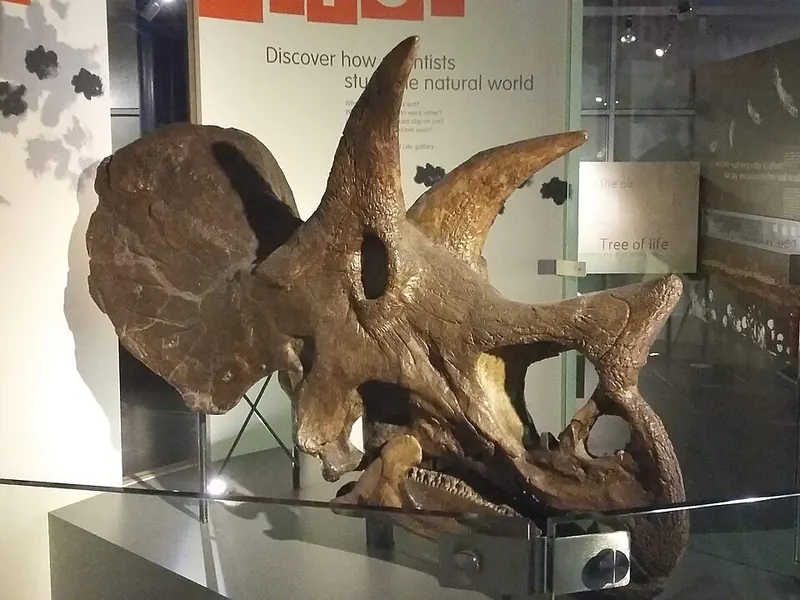
The short version
Triceratops means “three-horned face”. Natural History Museum: Triceratops (Dino Directory) Triceratops was named by Othniel Charles Marsh in 1889. Natural History Museum: Triceratops (Dino Directory)
It lived in the Late Cretaceous, 68 to 66 million years ago. Natural History Museum: Triceratops (Dino Directory) Triceratops was a herbivore: a plant eater. Natural History Museum: Triceratops (Dino Directory)
With its three horns, parrot-like beak and a frill nearly a metre across, its skull is one of the largest of any land animal. Natural History Museum: Triceratops (Dino Directory)
Triceratops is the most abundant dinosaur in Montana’s Hell Creek Formation: more than 50 skulls have been collected there. Scannella, Fowler, Goodwin & Horner (2014), Evolutionary trends in Triceratops, PNAS · checked 27 Oct 2026
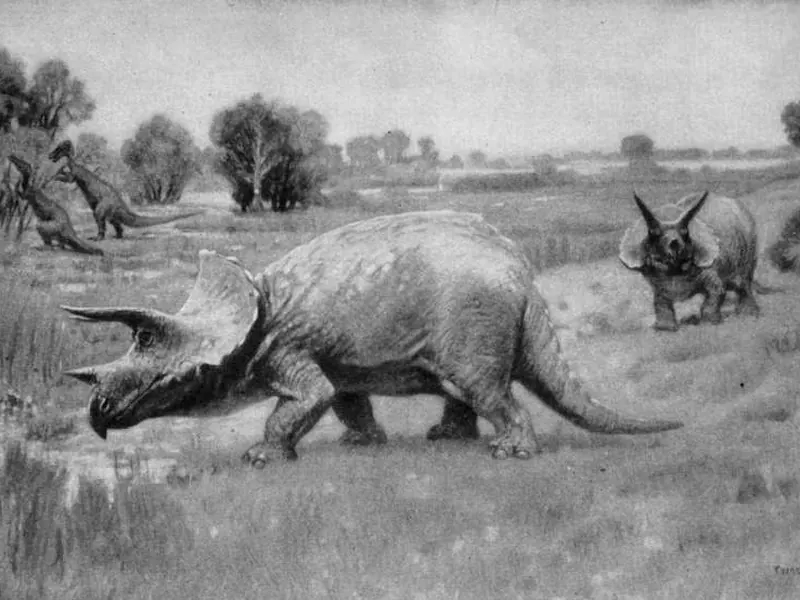
Grow a Triceratops
Baby Triceratops didn’t look like small adults. Its brow horns changed shape as it grew: straight stubs in babies, curving backwards in juveniles, straightening in subadults, and curving forwards in adults. Horner & Goodwin (2006), Major cranial changes during Triceratops ontogeny, Proc. R. Soc. B Drag the slider and watch it happen.
Baby
- Brow horns
- Straight stubs
- Frill edge
- Deeply scalloped edge, no bony points yet
- Skull length
- 38 cm (estimated)
- Brow horn above the eye
- 3.5 cm
- Specimen
- UCMP 154452
Juvenile
- Brow horns
- Curving backwards
- Frill edge
- 17 to 19 small triangular bony points along a scalloped edge
- Skull length
- 110 cm
- Brow horn above the eye
- 40 cm
- Specimen
- UCMP 136306
Subadult
- Brow horns
- Straightening up
- Frill edge
- The bony points flatten; the edge turns wavy
- Skull length
- 165 cm
- Brow horn above the eye
- 53 cm
- Specimen
- MOR 1120
Adult
- Brow horns
- Curving forwards
- Frill edge
- Points stretched flat and, in older adults, merged into a smooth edge
- Skull length
- 225 cm
- Brow horn above the eye
- 82 cm
- Specimen
- UCMP 113697
Drawings above are our own schematics, all drawn the same size so you can compare shapes. The bars show the real measured skulls: UCMP 154452, UCMP 136306, MOR 1120 and UCMP 113697. Horner & Goodwin (2006), Major cranial changes during Triceratops ontogeny, Proc. R. Soc. B Horner & Goodwin (2006), Major cranial changes during Triceratops ontogeny, Proc. R. Soc. B
Start exploring
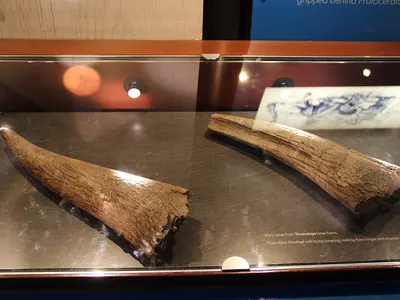 Horns, frill, beak & teethKeratin-covered horns, self-sharpening teeth and pebbled skin.
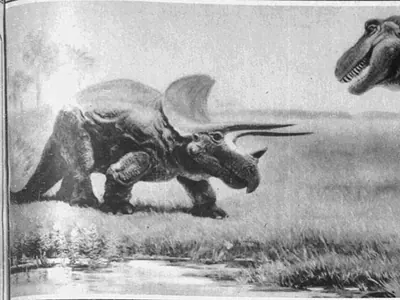 How it livedPlant eating, living alone, locking horns, and run-ins with T. rex.
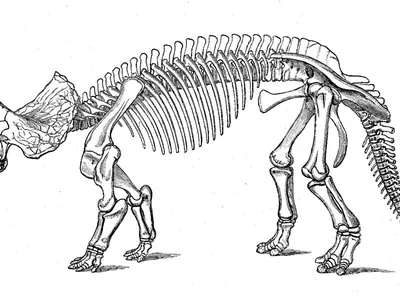 Discovery & HatcherA giant “bison”, 16 species named, and the Smithsonian’s 10-animal skeleton.
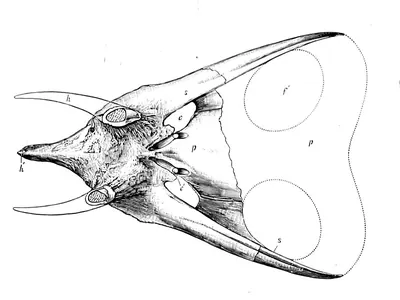 The Torosaurus debateWas Torosaurus just an old Triceratops? The evidence on both sides.
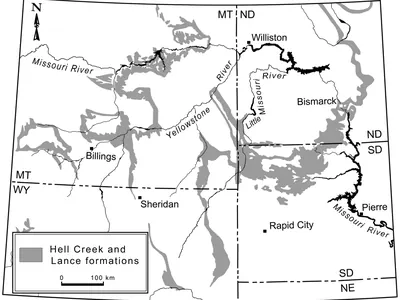 Its world & relativesHell Creek, its neighbours, its horned cousins and the asteroid.
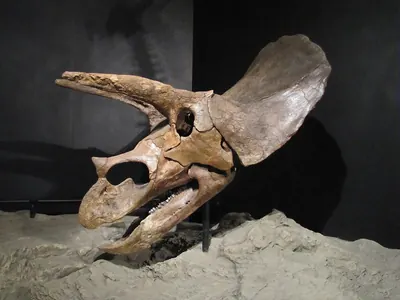 Myths vs factsRhinos, herds, horn-swords and that famous fight.
Tile images are credited on their pages and on the credits page.
Ten animals, one skeleton
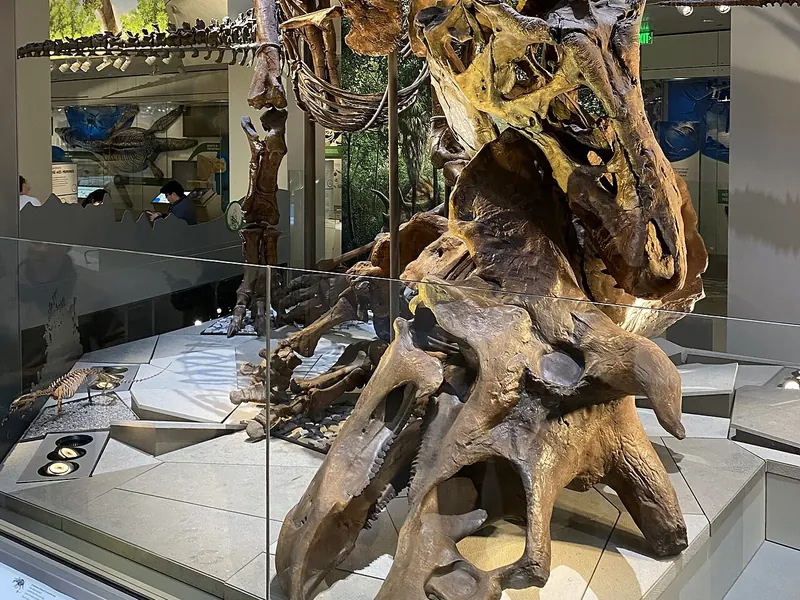
In 1905 Hatcher became the world’s first Triceratops to go on exhibit, and for more than 20 years it was the only one on display anywhere. Smithsonian Voices (NMNH): An elegy for Hatcher the Triceratops, 2018 No complete Triceratops skeleton had been found, so the 1905 mount combined bones from 10 different animals. Smithsonian Voices (NMNH): An elegy for Hatcher the Triceratops, 2018
Bitten, and lived
A Triceratops fossil collected in 1997 has a horn bitten off, with bite marks that match Tyrannosaurus. The horn healed, so that Triceratops survived. Natural History Museum: Triceratops (Dino Directory) More on the life page.
Enjoying the Triceratops? Help keep the lights on.
This site is hand-built, fact-checked and free to read. If a fact, a game or one of Useless’s notes made you smile, a little support keeps it going and helps the network grow.
Triceratops printables
Fact-checked PDFs in A4 and US Letter.
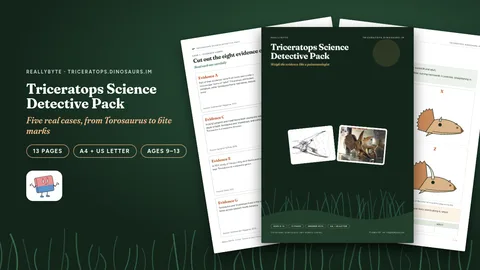
Triceratops Science Detective Pack
Five real cases to solve like a palaeontologist: was Torosaurus a grown-up Triceratops? Evidence cards, a growth-stage sort, bite marks, rock layers and the frill, with answer keys
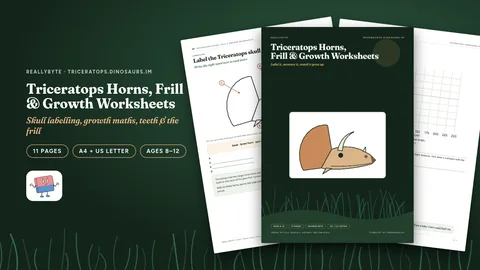
Triceratops Horns, Frill & Growth Worksheets
Label the skull, follow the horns from baby to adult, skull-length maths and a bar chart, teeth, the frill and a true or false quiz, with an answer key
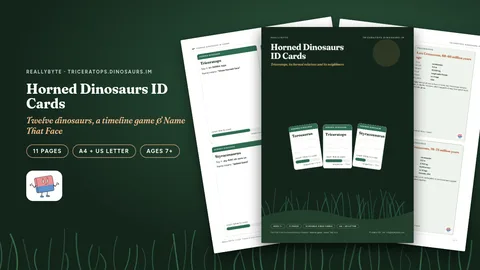
Horned Dinosaurs ID Cards
Twelve double-sided cards: eight horned dinosaurs, from Triceratops to Psittacosaurus, plus four other Late Cretaceous dinosaurs, with a timeline game and a Name That Face game
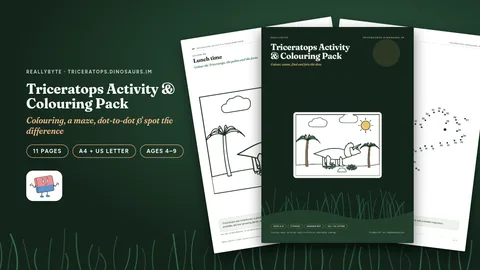
Triceratops Activity & Colouring Pack
Colouring scenes, a maze, dot-to-dot, spot the difference and puzzles for ages 4 to 9
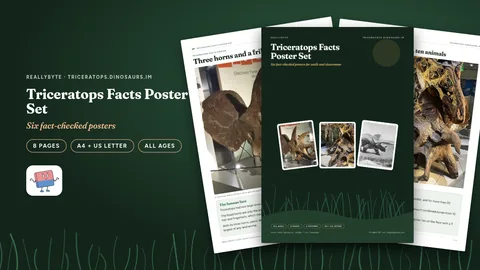
Triceratops Facts Poster Set
Six fact-checked posters, from 800 teeth to Hatcher, the Smithsonian’s 10-animal Triceratops
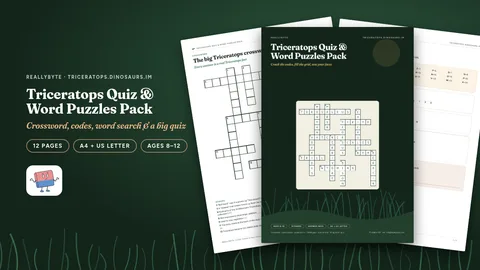
Triceratops Quiz & Word Puzzles Pack
A crossword, code breaker, word search, fill-the-gap facts, true or false and a 16-question quiz, with answer keys
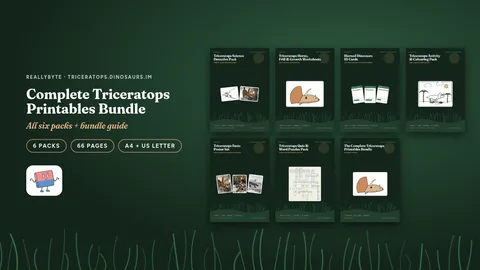 Best value
The Complete Triceratops Printables Bundle
All six packs plus a guide, A4 and US Letter, in one download.