Things everybody “knows” about Triceratops
Some came from films, some from old museum displays, and one from a newspaper headline in 2010.
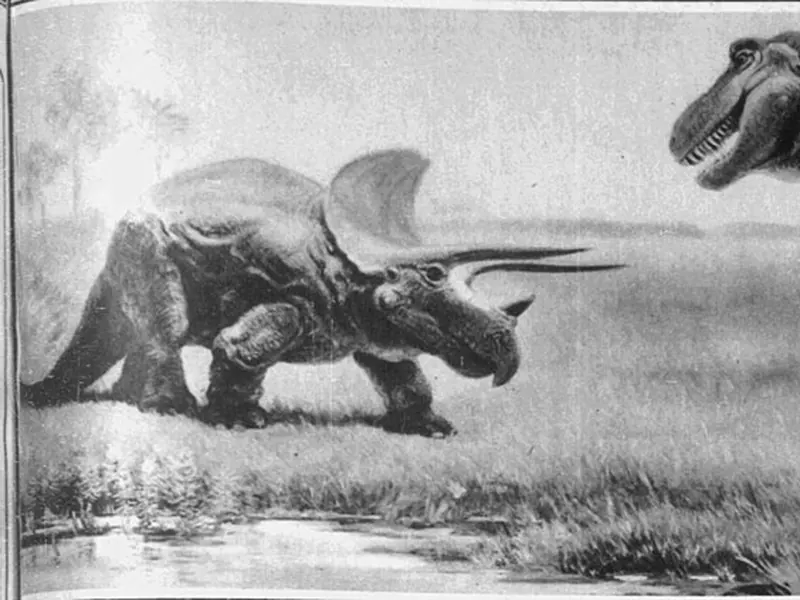
Myth Triceratops was a kind of dinosaur rhino.
Fact Triceratops wasn’t related to rhinoceroses. They look a bit alike because of convergent evolution: unrelated animals evolving similar shapes. Natural History Museum: Triceratops (Dino Directory)
Myth Triceratops lived in big herds, like bison.
Fact Many horned dinosaurs lived in herds, but Triceratops remains are usually found alone, which suggests it may have spent much of its life alone. Natural History Museum: Triceratops (Dino Directory)
Myth Its horns were just bare bone.
Fact The fossil horns are only the bony horn cores. In life they were covered in keratin, the stuff of our hair and fingernails, which made them longer and sharper. Natural History Museum: Triceratops (Dino Directory)
Myth Baby Triceratops looked like small adults.
Fact Its brow horns changed shape as it grew: straight stubs in babies, curving backwards in juveniles, straightening in subadults, and curving forwards in adults. Horner & Goodwin (2006), Major cranial changes during Triceratops ontogeny, Proc. R. Soc. B A baby’s frill edge was deeply scalloped. Juveniles grew 17 to 19 small triangular bony points along it, which flattened with age and finally merged into the frill in older adults. Horner & Goodwin (2006), Major cranial changes during Triceratops ontogeny, Proc. R. Soc. B
Myth The frill was definitely armour.
Fact The frill might have protected its neck. It could also have helped attract mates, or let Triceratops recognise each other. Natural History Museum: Triceratops (Dino Directory)
Myth Triceratops is being renamed Torosaurus.
Fact If they were the same animal, Triceratops would keep its name, because it was named first (1889) and Torosaurus later (1891). Smithsonian Magazine: Relax, Triceratops really did exist, 2010
Myth Triceratops lived at the same time as all the other horned dinosaurs.
Fact It lived in the Late Cretaceous, 68 to 66 million years ago. Natural History Museum: Triceratops (Dino Directory) Psittacosaurus: “parrot lizard”, a ceratopsian 2 m long that walked on 2 or 4 legs, 120 to 100 million years ago in the Early Cretaceous. Natural History Museum: Psittacosaurus (Dino Directory)
Myth T. rex always won.
Fact A Triceratops fossil collected in 1997 has a horn bitten off, with bite marks that match Tyrannosaurus. The horn healed, so that Triceratops survived. Natural History Museum: Triceratops (Dino Directory)
Myth Every museum Triceratops is one animal.
Fact No complete Triceratops skeleton had been found, so the 1905 mount combined bones from 10 different animals. Smithsonian Voices (NMNH): An elegy for Hatcher the Triceratops, 2018