From a giant “bison” to Hatcher
It started with a pair of horns that its discoverer got completely wrong.
The bison that wasn’t
Marsh’s first find, in 1887, was a pair of horn cores. Natural History Museum: Triceratops (Dino Directory) Marsh first thought the horn cores came from a giant bison, and called them Bison alticornis. Natural History Museum: Triceratops (Dino Directory)
The fossil horns are only the bony horn cores. In life they were covered in keratin, the stuff of our hair and fingernails, which made them longer and sharper. Natural History Museum: Triceratops (Dino Directory)
As more remains turned up, Marsh realised they belonged to a three-horned dinosaur, which he called Triceratops. Natural History Museum: Triceratops (Dino Directory) Triceratops was named by Othniel Charles Marsh in 1889. Natural History Museum: Triceratops (Dino Directory)
Sixteen species, then two
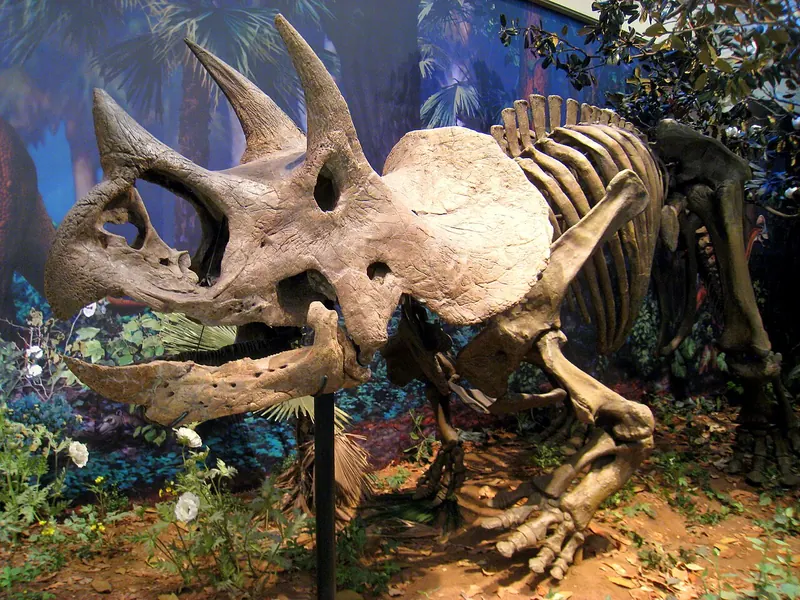
The wide variety of skulls probably just means individual Triceratops could look quite different from one another. Natural History Museum: Triceratops (Dino Directory) As many as 16 species of Triceratops were named over the years, based on differences in skull shape. Scannella, Fowler, Goodwin & Horner (2014), Evolutionary trends in Triceratops, PNAS
A later review recognised only two species, T. horridus and T. prorsus, which differ in things like the length of the brow horns. Scannella, Fowler, Goodwin & Horner (2014), Evolutionary trends in Triceratops, PNAS Today scientists recognise two species: Triceratops horridus and Triceratops prorsus. Natural History Museum: Triceratops (Dino Directory) · checked 27 Oct 2026
One species turning into another?
In Montana, T. horridus is found lower in the Hell Creek rocks and T. prorsus in the upper third, with in-between forms in the middle. Scannella, Fowler, Goodwin & Horner (2014), Evolutionary trends in Triceratops, PNAS That pattern suggests Triceratops was slowly changing over time, one species transforming into the next. Scannella, Fowler, Goodwin & Horner (2014), Evolutionary trends in Triceratops, PNAS
Those changes happened over a geologically short time: 1 to 2 million years. Scannella, Fowler, Goodwin & Horner (2014), Evolutionary trends in Triceratops, PNAS
Hatcher, the Smithsonian’s Triceratops
The Smithsonian’s Triceratops “Hatcher” was collected by John B. Hatcher in Niobrara County, Wyoming, in 1890. Smithsonian NMNH collection record: Triceratops horridus (“Hatcher”), USNM PAL500000 In 1905 Hatcher became the world’s first Triceratops to go on exhibit, and for more than 20 years it was the only one on display anywhere. Smithsonian Voices (NMNH): An elegy for Hatcher the Triceratops, 2018
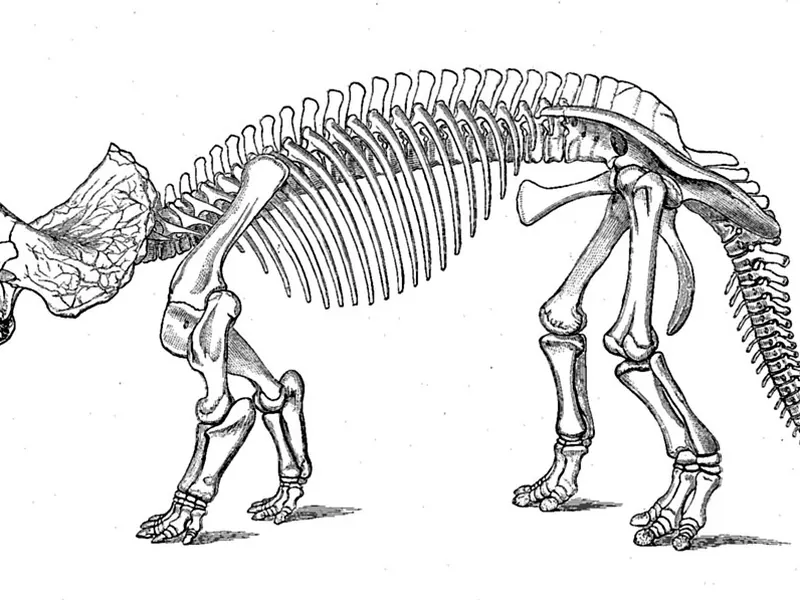
No complete Triceratops skeleton had been found, so the 1905 mount combined bones from 10 different animals. Smithsonian Voices (NMNH): An elegy for Hatcher the Triceratops, 2018 The skull was too small for the body, the front legs were different lengths, and the back feet came from a different species with the wrong number of toes. Smithsonian Voices (NMNH): An elegy for Hatcher the Triceratops, 2018
In 1996 a chunk of Hatcher’s pelvis fell off in front of a visitor. The bones had pyrite disease, which breaks fossils up from the inside. Smithsonian Voices (NMNH): An elegy for Hatcher the Triceratops, 2018 While it was off display, the Smithsonian made the first 3D scan of an entire dinosaur skeleton. Smithsonian Voices (NMNH): An elegy for Hatcher the Triceratops, 2018
In 2001 Hatcher went back on show in a more upright pose, worked out with Triceratops experts. Smithsonian Voices (NMNH): An elegy for Hatcher the Triceratops, 2018 Hatcher’s ribs are 6 feet (about 1.8 m) long. Smithsonian Voices (NMNH): An elegy for Hatcher the Triceratops, 2018
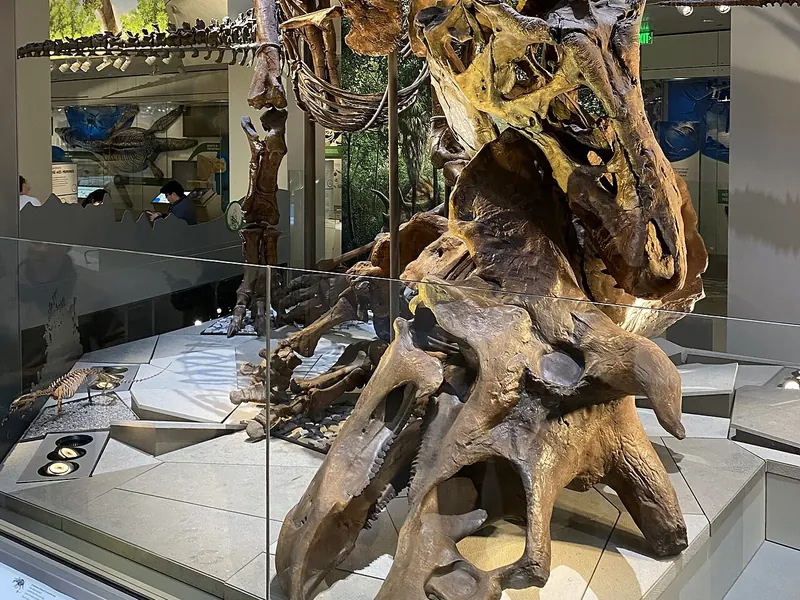
In the Smithsonian’s Deep Time hall, opened in 2019, a cast of Hatcher lies on the floor with a T. rex standing on its ribs. Smithsonian Voices (NMNH): An elegy for Hatcher the Triceratops, 2018 · checked 27 Oct 2026 The original bones are now kept safely in the museum’s collections for research. Smithsonian Magazine: Meet the dinos of “Deep Time”, 2019
An early mix-up with T. rex
Some of the first T. rex bones were named Manospondylus gigas in 1892 by Edward Drinker Cope, who thought they came from a Triceratops-like dinosaur. Natural History Museum: Tyrannosaurus (Dino Directory)
State symbols
Triceratops is the official state fossil of South Dakota. South Dakota Codified Law 1-6-16.1: State fossil Triceratops is Wyoming’s state dinosaur, adopted on 18 March 1994. State of Wyoming: Wyoming facts and symbols
Next: the Torosaurus debate →