How Triceratops lived
A big plant eater that probably spent much of its time alone, sometimes locked horns with its own kind, and lived alongside Tyrannosaurus.
What it ate
Triceratops was a herbivore: a plant eater. Natural History Museum: Triceratops (Dino Directory) It probably ate low-growing plants, and could raise its head to reach slightly higher. Natural History Museum: Triceratops (Dino Directory)
The Smithsonian describes it munching on shrubs and palms. Smithsonian Magazine: Meet the dinos of “Deep Time”, 2019 It may have used its frill and horns to push through dense plants, or to defend itself while feeding. Natural History Museum: Triceratops (Dino Directory)
Alone or in herds?
Many horned dinosaurs lived in herds, but Triceratops remains are usually found alone, which suggests it may have spent much of its life alone. Natural History Museum: Triceratops (Dino Directory)
“Usually found individually” is a clue, not proof: fossils record where bodies ended up, not every animal’s social life.
Locking horns
A 2009 study found Triceratops had more injuries on the squamosal bone of its frill than Centrosaurus did, which fits Triceratops locking horns and the frill acting as a shield. Farke, Wolff & Tanke (2009), Evidence of combat in Triceratops, PLOS ONE
The Natural History Museum says puncture marks on frills show males fought each other, probably to impress females. Natural History Museum: Triceratops (Dino Directory)
Triceratops and T. rex
T. rex lived at the same time, 68 to 66 million years ago, in the Natural History Museum’s directory. Natural History Museum: Tyrannosaurus (Dino Directory) Triceratops might have used its horns to fend off Tyrannosaurus. Natural History Museum: Triceratops (Dino Directory)
A Triceratops fossil collected in 1997 has a horn bitten off, with bite marks that match Tyrannosaurus. The horn healed, so that Triceratops survived. Natural History Museum: Triceratops (Dino Directory) Some specimens show Tyrannosaurus bite marks punched through the frill, so it wasn’t always enough protection. Natural History Museum: Triceratops (Dino Directory)
Smithsonian curator Matthew Carrano says some Triceratops skulls bear the telltale hole punches of T. rex teeth. Smithsonian Voices (NMNH): Q&A on the T. rex’s new pose, 2018
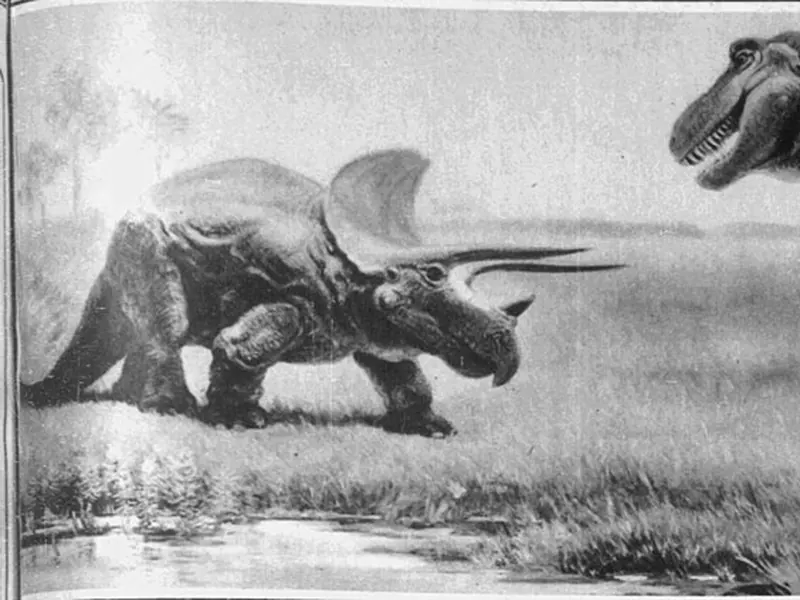
Did T. rex kill Hatcher?
In the Smithsonian’s Deep Time hall, opened in 2019, a cast of Hatcher lies on the floor with a T. rex standing on its ribs. Smithsonian Voices (NMNH): An elegy for Hatcher the Triceratops, 2018 · checked 27 Oct 2026 Was it killed or scavenged? Curator Matthew Carrano says that unless new evidence turns up, the T. rex just as likely scavenged Hatcher after something else killed it. Smithsonian Voices (NMNH): An elegy for Hatcher the Triceratops, 2018
Growing up
Its brow horns changed shape as it grew: straight stubs in babies, curving backwards in juveniles, straightening in subadults, and curving forwards in adults. Horner & Goodwin (2006), Major cranial changes during Triceratops ontogeny, Proc. R. Soc. B See it on the Grow a Triceratops page.
Lengths and weights for Triceratops are estimates from fossils, and different sources give different answers: the Natural History Museum says 9 m and 10 tonnes, a 2015 study says up to 9 m, and the Smithsonian says roughly elephant-sized. Where we give a figure, the source link says who said it and the date we checked it.
Next: how it was discovered →