Hell Creek, the neighbours and the relatives
Triceratops lived right at the end of the age of dinosaurs, in warm country in western North America.
Where it’s found
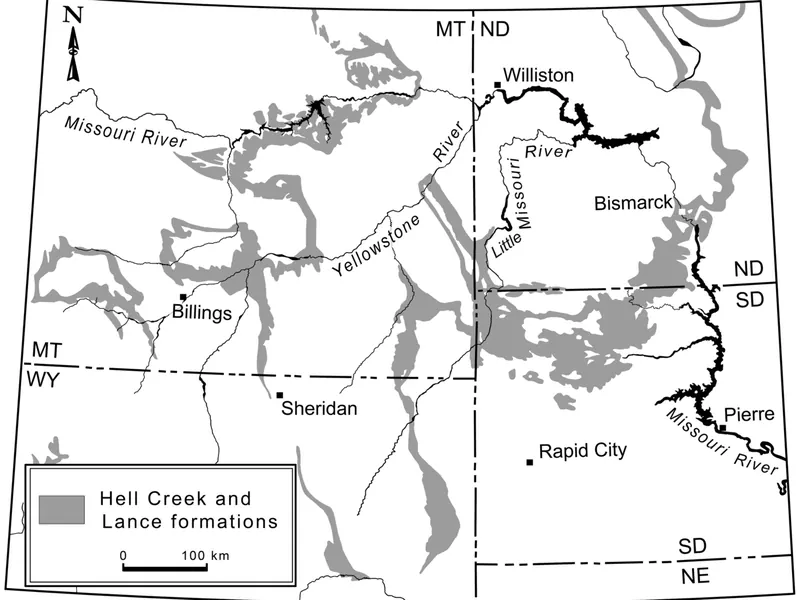
Triceratops fossils come from rock layers such as the Hell Creek Formation in Montana and the Dakotas and the Lance Formation in Wyoming. Longrich & Field (2012), Torosaurus is not Triceratops, PLOS ONE Triceratops is the most abundant dinosaur in Montana’s Hell Creek Formation: more than 50 skulls have been collected there. Scannella, Fowler, Goodwin & Horner (2014), Evolutionary trends in Triceratops, PNAS · checked 27 Oct 2026
The neighbours
Pachycephalosaurus shared its habitat with Tyrannosaurus, Triceratops and Ankylosaurus. Natural History Museum: Pachycephalosaurus (Dino Directory) The environment was subtropical, with warm, humid air and many flowering plants. Natural History Museum: Pachycephalosaurus (Dino Directory)
T. rex lived at the same time, 68 to 66 million years ago, in the Natural History Museum’s directory. Natural History Museum: Tyrannosaurus (Dino Directory)
Ankylosaurus, the armoured dinosaur with a tail club, also lived 68 to 66 million years ago, and its first bones came from the Hell Creek Formation in 1906. Natural History Museum: Ankylosaurus (Dino Directory) Edmontosaurus, a duck-billed dinosaur, had a beak and about 1,000 grinding cheek teeth. Natural History Museum: Edmontosaurus (Dino Directory)
The horned relatives
Torosaurus
Torosaurus: “bull lizard”, about 7.5 m long, with the largest display crest of any ceratopsian. Natural History Museum: Torosaurus (Dino Directory) Torosaurus lived 70 to 66 million years ago, and its fossils come from Canada and the USA. Natural History Museum: Torosaurus (Dino Directory)
Styracosaurus
Styracosaurus: “spiked lizard”, 5.5 m long, with long spikes around its frill and a huge nose horn. Natural History Museum: Styracosaurus (Dino Directory) Several Styracosaurus found together in one bone bed suggest they lived and died together. Natural History Museum: Styracosaurus (Dino Directory)
Centrosaurus
Centrosaurus: “sharp pointed lizard”, 6 m long, with one horn on its snout and spines on its frill. Natural History Museum: Centrosaurus (Dino Directory)
Chasmosaurus
Chasmosaurus: “chasm lizard”, 5 m long, with a small nose horn, blunt brow horns and a long frill with holes. Natural History Museum: Chasmosaurus (Dino Directory)
Pentaceratops
Pentaceratops: “five-horned face”, 6.8 m long, with a skull almost 3 m long. Natural History Museum: Pentaceratops (Dino Directory)
Protoceratops
Protoceratops: “first horned face”, 1.8 m long, from China and Mongolia, 74 to 70 million years ago. Natural History Museum: Protoceratops (Dino Directory) One Protoceratops was fossilised while being attacked by Velociraptor. Natural History Museum: Protoceratops (Dino Directory)
Psittacosaurus
Psittacosaurus: “parrot lizard”, a ceratopsian 2 m long that walked on 2 or 4 legs, 120 to 100 million years ago in the Early Cretaceous. Natural History Museum: Psittacosaurus (Dino Directory)
The end
Sixty-six million years ago an asteroid hit Earth and ended the age of the dinosaurs. Natural History Museum: How an asteroid ended the age of the dinosaurs About 75% of all animals died out. Natural History Museum: How an asteroid ended the age of the dinosaurs
The asteroid was probably 10 to 15 km wide and made the Chicxulub crater, 150 km across, centred on Mexico’s Yucatán Peninsula. Natural History Museum: How an asteroid ended the age of the dinosaurs
Triceratops was among the last non-bird dinosaurs: its teeth studied in 2015 are about 66 million years old. Erickson et al. (2015), Wear biomechanics in the slicing dentition of Triceratops, Science Advances
Next: myths vs facts →