Horns, frill, beak and teeth
One of the biggest heads of any land animal, on a heavy four-legged body.
That head
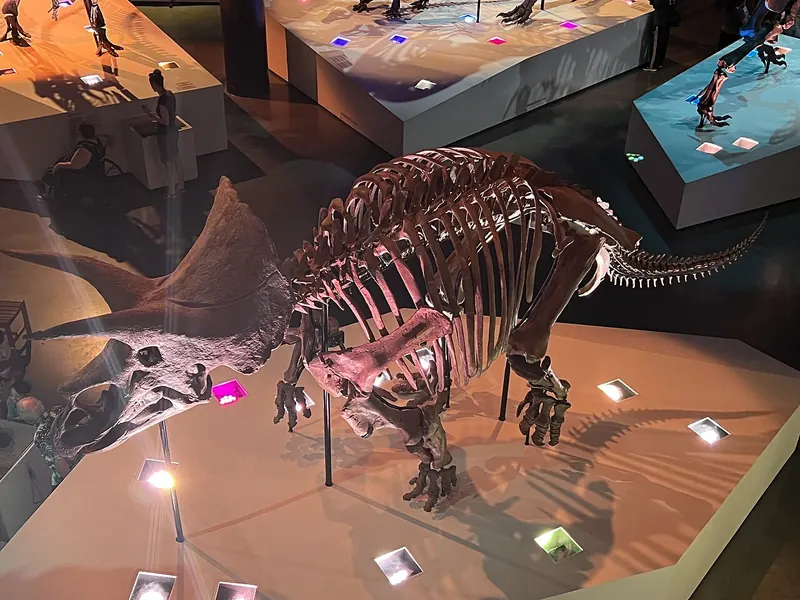
With its three horns, parrot-like beak and a frill nearly a metre across, its skull is one of the largest of any land animal. Natural History Museum: Triceratops (Dino Directory) Its head was huge: about one-third the length of its whole body, according to the Smithsonian. Smithsonian Magazine: Meet the dinos of “Deep Time”, 2019
It walked on four legs. Natural History Museum: Triceratops (Dino Directory) It was a ceratopsian, a horned dinosaur, in the group called chasmosaurines. Natural History Museum: Triceratops (Dino Directory)
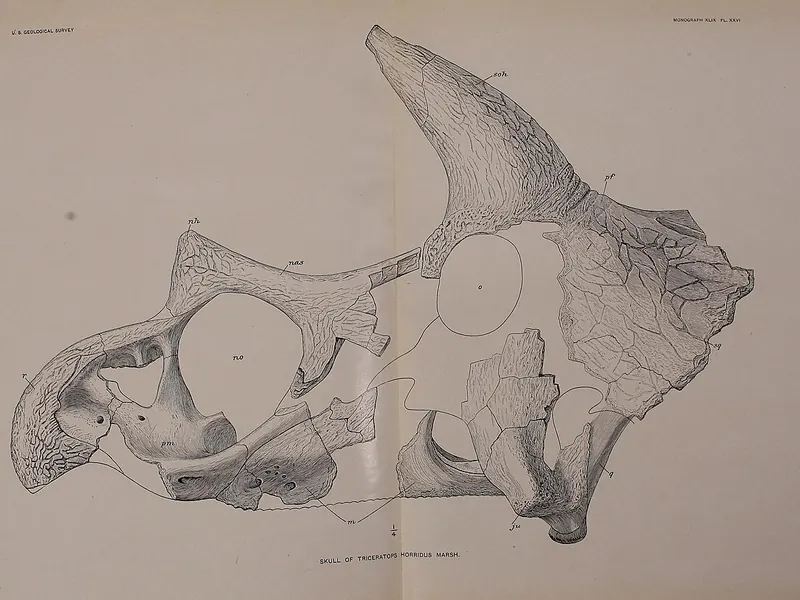
Three horns
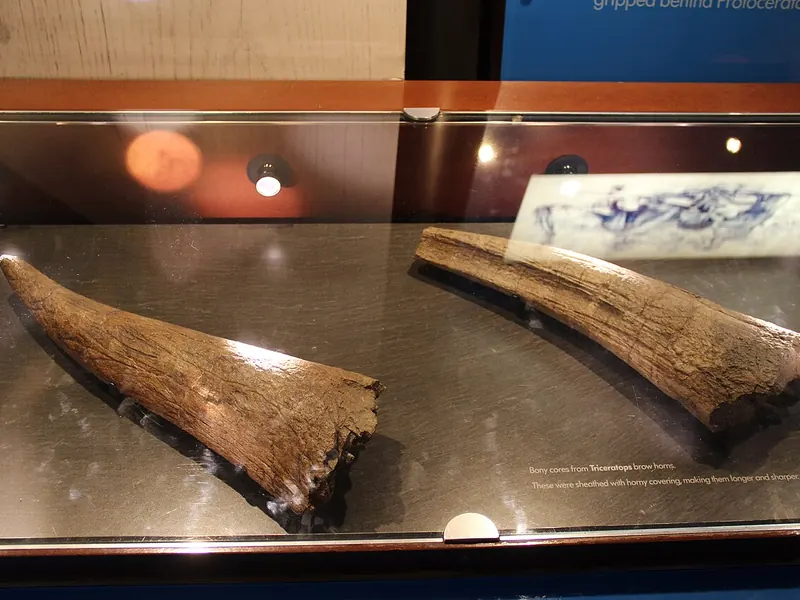
Triceratops had two large brow horns and a smaller nose horn. Farke, Wolff & Tanke (2009), Evidence of combat in Triceratops, PLOS ONE The fossil horns are only the bony horn cores. In life they were covered in keratin, the stuff of our hair and fingernails, which made them longer and sharper. Natural History Museum: Triceratops (Dino Directory)
Chasmosaurines like Triceratops tended to have short nose horns and big brow horns. Centrosaurines, like Styracosaurus, had long nose horns. Natural History Museum: Styracosaurus (Dino Directory)
The frill
Triceratops had a solid frill, without the big holes seen in some relatives. Longrich & Field (2012), Torosaurus is not Triceratops, PLOS ONE The frill might have protected its neck. It could also have helped attract mates, or let Triceratops recognise each other. Natural History Museum: Triceratops (Dino Directory)
A 2009 study found Triceratops had more injuries on the squamosal bone of its frill than Centrosaurus did, which fits Triceratops locking horns and the frill acting as a shield. Farke, Wolff & Tanke (2009), Evidence of combat in Triceratops, PLOS ONE
So it may have done several jobs. Scientists still debate which mattered most.
Beak and teeth
It had a sharp beak to snip vegetation, and rows of teeth at the back of the jaws that formed shearing surfaces. Natural History Museum: Triceratops (Dino Directory) The Smithsonian says its beak-like mouth held up to 800 teeth. Smithsonian Magazine: Meet the dinos of “Deep Time”, 2019
Its teeth wore down as it fed into self-sharpening slicing blades, a 2015 study found. Erickson et al. (2015), Wear biomechanics in the slicing dentition of Triceratops, Science Advances Each tooth was built from five different hard tissues, more than the most complex mammal teeth, which have four. Erickson et al. (2015), Wear biomechanics in the slicing dentition of Triceratops, Science Advances
The Natural History Museum lists its food as tough palm fronds. Natural History Museum: Triceratops (Dino Directory)
Skin
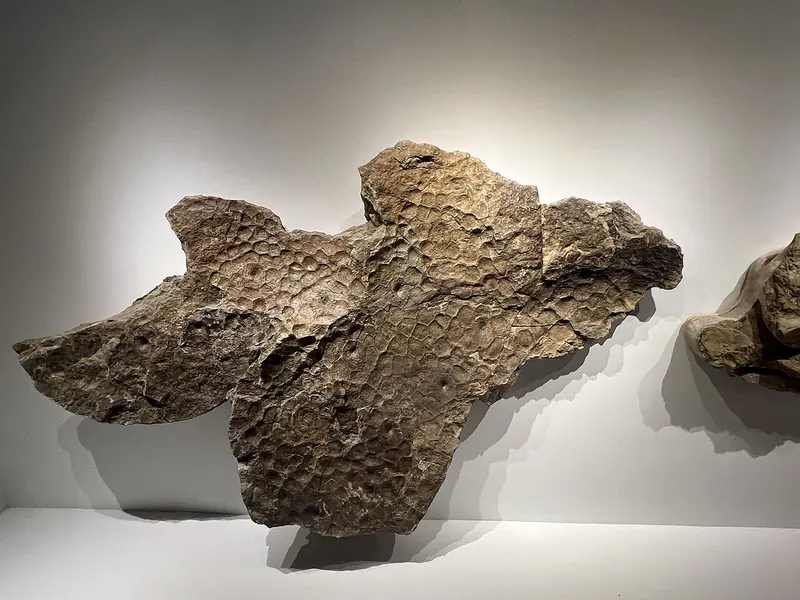
Skin impressions show Triceratops had large, pebbled scales. Natural History Museum: Triceratops (Dino Directory)
Not a rhino
Triceratops wasn’t related to rhinoceroses. They look a bit alike because of convergent evolution: unrelated animals evolving similar shapes. Natural History Museum: Triceratops (Dino Directory)
Lengths and weights for Triceratops are estimates from fossils, and different sources give different answers: the Natural History Museum says 9 m and 10 tonnes, a 2015 study says up to 9 m, and the Smithsonian says roughly elephant-sized. Where we give a figure, the source link says who said it and the date we checked it.
Next: how it lived →